Mains-Voltage LED Strip: When to Skip the Transformer
A mains-voltage strip removes the step-down driver from the circuit, but not the voltage-matching decisions it used to make for you.
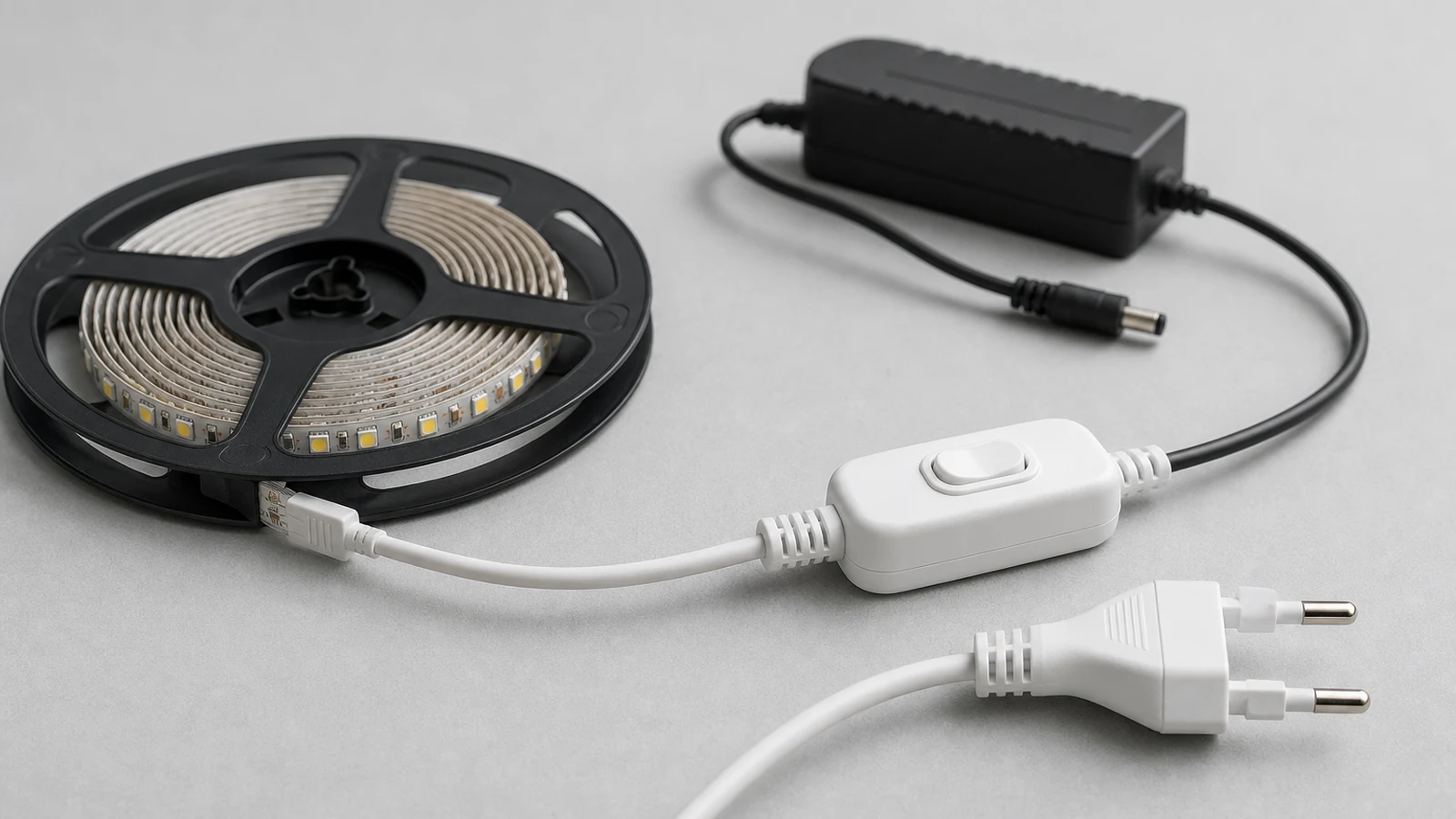
Why a mains-voltage LED strip changes the installation, not just the spec sheet
A 110V or 220V LED strip plugs into mains power directly, without a step-down transformer or low-voltage driver in the circuit. That removes one component from a bill of materials, but it does not remove the electrical design decisions a transformer used to absorb. On a 12V or 24V system, the driver sets the safe working voltage before it ever reaches the strip. On a mains-voltage strip, the strip itself is the component rated for mains input, and every accessory connected to it — plugs, inline switches, joiners, end caps — has to be rated for the same voltage.
This matters most at the point where buyers substitute parts across voltage families. A plug, switch or connector pulled from a 12V project is not a drop-in replacement on a 110V or 220V run, even when the physical connector shape looks identical. ULANTU's own catalog documentation makes this explicit on a 12V/220V neon flex configuration: the two voltage versions "come from one SKU; do not apply 12V power-supply instructions to a 220V reel." That warning exists because the failure mode is not a performance shortfall — it is a safety hazard.
Confirm 110V or 220V before anything else
"Mains voltage" is not one number. It covers a documented range of real input voltages, and ULANTU's current catalog lists mains-voltage configurations at 110V, 220V, 230V and 240V depending on the exact SKU and destination market. Some products ship as separate SKUs for each mains voltage; others list both options as variants within a single product family. Confirm the voltage tied to the exact SKU, not the voltage printed on a different product's listing in the same category.
For reference, the live mains-voltage range covers three different formats:
- COB strips — a COB strip family currently spans 5V, 12V, 24V, 110V and 220V configurations within a single product line, with each voltage requiring its own matching accessories.
- SMD/2835 strips — several encapsulated SMD strips list 220V as the primary configuration, including strips with inline switches and plug-and-play accessories already matched to that voltage.
- LED neon flex — a 2835 neon flex product offers 12V 5m kits and bulk reels alongside a separately listed 220V 100m reel configuration, reinforcing that the kit accessories are not interchangeable across the two voltage versions.
Do not infer that because one COB or SMD product in the catalog is available at 220V, every product in that category also has a 220V option. Each SKU documents its own voltage range; confirm it on the specific product page before specifying a mains-voltage run.
LED density and cut intervals change with voltage, even on the same product family
Switching voltage on a mains-voltage strip is not only a wiring difference — the physical strip specification itself can change. One COB product family in the catalog lists 296 LEDs/m at its 110V configuration and 288 LEDs/m at its 220V configuration, inside the same product. Treat the voltage and LED density as a matched pair documented on that specific variant, not as two independent choices.
Cut intervals follow the same pattern of being voltage- and product-specific rather than a fixed industry number. A 220V silicone-encapsulated COB strip in the catalog lists a 50 cm cut interval — longer than the 2.5–5 cm intervals typical on many low-voltage strips, because a mains-voltage strip's cut points have to preserve the onboard circuitry that handles the higher input voltage. Cutting at an unmarked position on a mains-voltage strip is a different failure mode than doing the same on a 12V or 24V run: it can leave a segment without the complete voltage-handling circuit it needs, not just a shorter-than-planned length.
That same 220V COB strip also illustrates how many configuration fields stack on a mains-voltage order: the listed set separates white-color temperature, length (eleven options from 1 m to 100 m), plug format (EU or two-flat-pin), and with-switch or without-switch leads — four fields that all have to be selected together, not independently. Confirm every one of these fields against the exact SKU rather than assuming a default combination.
What changes when you remove the transformer
A low-voltage system (5V, 12V, 24V) uses a driver to step mains power down before it reaches the strip. That driver absorbs voltage-drop calculations, isolates the strip from direct mains contact, and is sized separately from the strip itself — see the power supply sizing and voltage-drop guide for that calculation method.
A mains-voltage strip skips that step: the strip runs directly from mains current, which means:
- The plug and switch become part of the strip's electrical rating, not a universal accessory. Several mains-voltage products in the catalog ship as kits with a matched plug and inline switch already specified for that voltage — these are not interchangeable with plugs pulled from a different-voltage kit.
- Cut and join points still need the same disconnection discipline, with higher stakes. Cutting or joining a mains-voltage strip without disconnecting power first is a different risk profile than doing so on a 12V run. Catalog selection notes for mains-voltage products consistently state to disconnect power before cutting and to cut only at marked positions.
- A separately selected controller does not inherit the strip's voltage rating. One encapsulated 110–220V RGB chasing strip in the catalog lists a Bluetooth/music controller as a fully separate selection — the controller's own input rating has to be confirmed independently, not assumed from the strip's mains-voltage listing.
- Outdoor or wet-location use still depends on sealed connections, not on the voltage alone. Mains-voltage strips used outdoors need the same end-seal and connection-sealing review as any other exposed run; a higher input voltage does not substitute for a documented protection rating at every joint.
Decide between mains-voltage and a stepped-down system
A mains-voltage LED strip is not a universal upgrade over a 12V or 24V system — it is a different wiring architecture suited to specific project constraints:
- Choose mains-voltage when the installation already has an accessible mains outlet at the strip location, the run is largely continuous rather than branching into many short zones, and a licensed electrician or qualified installer will handle the connection.
- Choose a stepped-down 12V/24V system when the layout needs to branch into multiple short, independently switched zones, when the installer is not working with mains-rated connections, or when the run needs to be cut and rejoined frequently during a fit-out — low-voltage systems tolerate that kind of in-field adjustment more predictably.
If the voltage decision is not settled yet, the 12V vs 24V LED strip system planning guide walks through that choice for stepped-down systems before a mains-voltage option is even on the table.
What to send for a mains-voltage project review
Confirm these points before requesting a mains-voltage quotation:
- Exact mains voltage at the destination — 110V, 220V, 230V or 240V, matched to the actual electrical standard at the installation site, not assumed from the country name alone.
- Total run length and whether it is one continuous circuit or several branches — this determines whether a single mains-voltage strip configuration covers the layout or whether the run needs to be split into separately switched sections.
- Who is making the mains connection — a licensed electrician, a qualified installer, or an end user — because this affects which plug, switch and connector configuration is appropriate for the project.
- Indoor or outdoor/wet-location exposure — each joint and end cap needs its own protection review regardless of the strip's advertised IP rating.
- The exact product ID, once a candidate is identified from the catalog, so the matched accessories (plug, switch, controller) can be confirmed against that specific SKU rather than assumed from a similar-looking product.
Compare current mains-voltage product configurations through a project brief, or request a sample of a specific mains-voltage candidate to confirm connection details before committing to a full run. An inquiry starts a review; it does not confirm voltage compatibility, stock, price, lead time, compliance, sample acceptance, production or an order.
Bring the comparison into a project brief.
Share the documented requirements and unresolved questions. An inquiry begins review; it does not confirm engineering approval, compatibility, stock, price, lead time, compliance or an order.
Prepare a project brief